The following was all part of the Portal 2 ARG that we participated in and is not really important any longer. Keeping it for historical reasons.
One thing I have been thinking about recently, is the direction in which the indie game scene seems to be heading. This is something that can be seen in upcoming of games, various talks, articles and what is considered the largest recent successes. It is a direction that might have large consequences for the future of the medium.
Quickly summed up, there is a strong design trend of making games by iterating and extending a fun core gameplay mechanic. This is then incorporated to a game with heavy emphasis on re-playability and/or ease to make levels. The main perks of this approach being that the game becomes more fun to create (as you can have fun at a very early stage), it makes it easier to home in on a "fun" core and allows for an early beta to be released (thus allowing feedback and income to trickle in before completion). This is of course a rough outline of the trend, but I still think it represent the main gist of where the industry of indie game development is heading.
Designing a game like this is of course perfectly fine. It makes sense financially and personally. By having a game where the fun comes in at a very early stage, it is much easier to discard bad ideas and figure out the best way to do things. Getting some kind of income before completion can be crucial for a start-up company, which is much easier when having an early playable version. Betas/alphas also help building a community and spreading the word. On the personal side, motivation comes a lot easier when almost every added feature add something to the gameplay and change is easily tracked. This can make up for other not so motivational aspects of being an indie (low income, non-existing security, bad working conditions, and so on and so forth). Summed up, making games like this make a lot of sense and it is not strange that it is a wide-spread trend.
However, what troubles me is that this kind of development is seen by most as THE way to design a game. While of course many great videos games can (and have!) come out of this manner of creation, it is not the only way to go about. I believe that doing games this way makes it impossible to do certain type of video games and to expand the medium in a way that I personally think is the most exciting. Because of the focus on instant gratification, gameplay will pull towards a local maximum and only take short term value into account. This disqualifies videogames that focus on more holistic experiences or has a non-trivial pay off (for instance, lowlevel gameplay that only becomes engaging in a certain higher-level context).
As an example of this, after finalizing the basic mechanics, it took six months before Amnesia: The Dark Descent became a somewhat engaging experience. Note that this time was not spend on perfecting the mechanics but on building the world in which they existed. Without the proper context, Amnesia's core mechanics are quite boring and it took additional layers, such as the sound-scape, high fidelity graphics, etc, to bring it home. With this I am not saying that Amnesia is the way forward for the medium. I am simply saying that a videogame like Amnesia could not have been made using the type of development that a large chunk of the indie scene (and mainstream for that matter too) is currently advocating!
Another thing that has also struck me is how many people that are interested in videogames with experiences not solely focused on a fun core. For example at GDC, we met many people, from many different places in the industry, saying how much they liked the game because of its non-gamey aspects. Also, most of the random people that we "dragged" in to the booth were very interested in this kind of experience and often surprised that videogames like Amnesia even existed. We have also seen this kind of response across the Internet, with many people wishing there were more games focusing on these aspects. Again, I am not saying that this means Amnesia is some candle bearer into the future. What I am saying is that there was an overwhelmingly positive attitude towards the kind of games where a fun core mechanic was not the focus.
However, because the current trend of developing games, this potential market will most likely go without many games.
A positive consequence of this is that it creates a potentially very profitable niche with almost no competition. So while the preferred way of making games might be more secure, these projects will be launched in an extremely competitive environment. I think this evens out some (all?) of the risks involved in a development not focused on quickly iterating fun mechanics.
A negative, possible devastating, consequence is that the lack of these kinds of video games might remove the market altogether (or at least limit it to a very niche one). What I mean here is that if the general population's view on view games is that they are just about "cheap thrills", people will never bother looking for anything else. Thus most people who would have been interested in more holistic video games, will never be exposed to them. In a worst case scenario, this would mean that these kind of game will pretty much be stopped being made.
I consider this is something worth thinking about and believe the critical cross road will come very soon. The video games we decide to make today, will shape the future for quite some time.
End note: For those wonder what other ways of designing games there might exist, check this post as a starter.
(Not read part 1? Do so here.)
Molding the Abomination
by Olof Strand (www.OlofStrand.com)
As a modeler the first thing I noted about this character was that the concept design demanded it to be completely unique in all of its parts. Usually it is possible to mirror some parts (e.g. an arm, a leg or some cloth piece) to save texture space and maybe some production time when modeling game characters. Not so this time.
The character was based on a human body type with various deformities and modifications done to it. This meant that I could easily use a regular human base mesh as a starting point. Using already existing meshes as a starting point is, when possible, very important for production efficiency.
Another thing that needed to be taken into consideration was how the character would be rigged for animation later on. In this case the rig would be shared with another character from the game and therefore needed to be built under certain specifications (joints in specific places, etc).
The basic mesh created before importing into Zbrush. (Click to enlarge.)
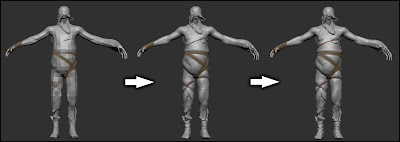
The different subdivision levels in z-brush. (Click to enlarge.)
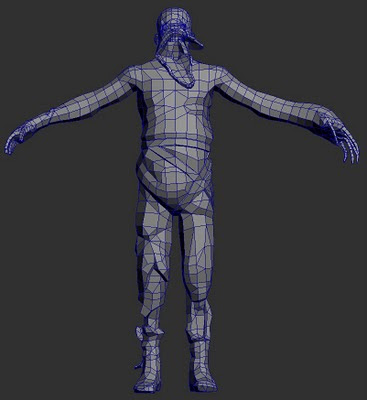
The final version of the low polygon mesh. (Click to enlarge.)
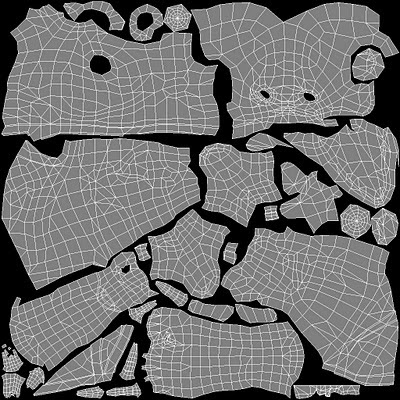
The uv-map layout. (Click to enlarge.)
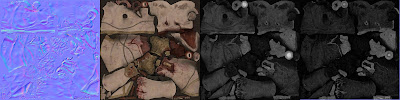
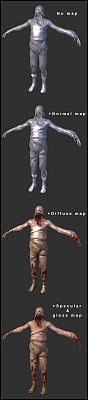
The final normal, diffuse, specular and gloss maps. Notice that all use the uv-map layout as base. (Click to enlarge.)
Renderings of final model using different setups of texture maps. (Click to enlarge.)
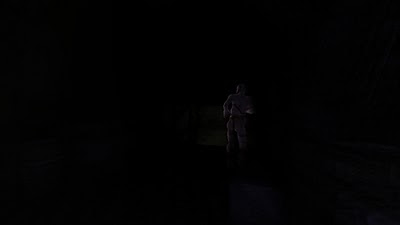
In-game screenshot showing of the rim-lighting on the creature. (Click to enlarge.)
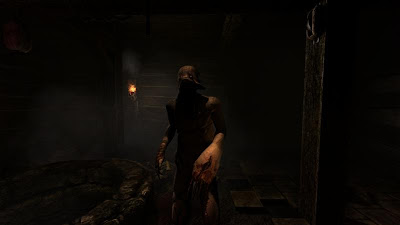
An in-game screenshot of the final rigged model in a scene. (Click to enlarge.)
(The following was supposed to be an article in a Russian magazine, but was never published. So because of that, I decided to post it on the blog instead. It was written in June 2010 by myself, Jonas Steinick Berlin and Olof Strand. Jonas and Olof were working as contractors for Frictional Games at the time. )
Creating Unspeakable Guidelines
by Thomas Grip (Frictional Games)
The following article outlines the process of creating a creature model from scratch for our first person horror game Amnesia: The Dark Descent. It will go through the basic thinking that went into the design of the enemy, how the concept images where made, how the mesh was built and finally how it was put into the game. For this work we used two extremely talented external artists and they have themselves outlined how their horrific creations came about below and it a future part. Before moving on to their work though, I will detail the thinking that went into the basic design of the creature.
When creating a horror game, making sure that the antagonistic creatures are properly designed is an extremely important issue. One wants to make sure the player faces something that feels frightening and works with the game's atmosphere and story. Another important aspect is to make sure that the enemy fits with gameplay. Certain movements might be required and it needs to fit, size-wise, into certain environments and situations. Finally you need to make sure that it is within the constraints of the available resources, something that is really important for small company such as ours. Having these three guidelines in mind I will now walk through the process of coming up with the core requirements for the enemy codenamed “Servant Grunt”.
My favorite way to go about when creating a creature is to take something normal and then add a disturbing twist to it. I also wanted some kind of character that the player could easily project agency to and believe it has motivations, imagining it more alive than it might actually be. Because of this I decided that we use some kind of human or at least humanoid entity, which is a shape that is easily recognizable (no other animal walks like a human) and which we all assume have feelings, desires and motives.
The problem with having a creature which gets the characteristics of a human projected on to it, is that the player will also assume it is intelligent. Because game AI is notorious for doing stupid things, this could easily break immersion. Having enemies do simple tasks like opening doors, avoiding obstacles and investigating strange noises in a believable human-like way is very hard to do. Hence, we had to have something in the design that hinted of stupidity, making it part of the immersion were the enemy to do something silly. Usually this means making something zombie-like, but I really did not want have something that cliché. This mean that I wanted the creature should look and feel stupid, yet still be as far away from a zombie as possible.
Avoiding clichés is usually something that ones does to keep things fresh, but in horror games a lot more is at stake. It is vital that the player does not feel familiar with the dangers faced as it drastically decreases fear and tension. It is when we are unsure about something and not able to predict or makes sense that true terror really emerges. For example, when building one of the game's maps, there was a vast difference in perceived horror between using an old, familiar enemy model from Penumbra (our previous game) and the new one discussed in this article.
Gameplay-wise the main constraint was that it had to walk in some human-like fashion and not crawl or move on all fours. This because we wanted to have a base collision that could easily fit into a cylinder, making it easier to code. For the first Penumbra game, we had dogs as the main enemy which, because they where four-legged, caused tons of issues. Something we wanted to avoid that this time around. Making sure implementation of the enemy is simple ties into saving resources. It was crucial that we did not want to have too many unknown factors when making the enemies. By making sure that most of the game's elements where familiar to us, we could much easier assure that we kept to the timetable and could spend time on polishing other parts of the game instead of trying to find AI bugs.
It was actually not until all of the above was determined that I started to figure out the story behind the creatures. This is not always the way we do it in our games, but this time it fit very well. Our basic story designs only referred to the enemies as “the servants” and did not talk much about their appearance or where they came from, so I had a lot of freedom to make a fitting background story to the guidelines. The finalized idea was that these “servants” were actually beings from beyond that had been summoned into bodies of humans. Once inside humans, they did their best to deform the host into a body that they are used to control, shattering bones, tearing flesh and producing cancer-like growths. This in turned resulted in a scene where the player witness how some humans under great pain are taken over, showing how designing graphics can shape the story, as well as the reverse.
With these basic guidelines completed, I contacted Jonas to start on the concept art.
Conceptualizing the Horror
by Jonas Steinick Berlin (pudjab [at] hotmail [dot] com)
Thomas gave me almost full creative freedom. The basic guidelines were that it had to be a humanoid and nothing like standard zombies, "The Infected" in Penumbra: Black Plague or the creatures in Dead Space. It should also fit the the story of demon-like creatures taking over human bodies and be super creepy. Apart from that, I was free to do pretty much what I wanted.
This was my first character design for a commercial game, so I was a little bit shaky. The great freedom was both exciting and quite overwhelming. So many choices! I first researched and got inspiration from unusual anatomy, photos 18- and 19th century clothing (the time in which the game takes place), surrealistic paintings and various disturbing stuff.
I then continued brainstorming and did a lot of small quick sketches of character silhouettes and different faces. I really wanted to avoid stereotypes and do something unique and memorable. Every single doodle got assembled on a collage and I then showed it for Thomas. He said which parts he liked and from that I went on and created something more detailed. At this time I had a design in my head that I really felt would be perfect. I drew it down with details, colors and lots of love. The result was something of a hunchback with interesting clothing fitting the era and a really grim face. This is perfect I said to myself! Excited I showed it for Thomas. However, I quickly got knocked down to earth again when he said that it looked too funky and resembled “Grodan Boll” (which is a character from a Swedish children's book taking the form of frog). I got instructed that I should avoid the cartoony style and make something more realistic, something that you almost could find in real life. Thomas also thought that it should have a lot less clothes.
The first batch of sketches. Contains the infamous “Grodan Boll” (“Frog Ball”) on the right. (Click to enlarge.)
The create is starting to shape up and the design of the head has been approved. It is not yet decided what to do with the lower jaw though (an issue discussed until the very end). (Click to enlarge!)
Clothes have been determined to be nothing but a few bandages. Also started studying how the head might look viewed from the side, which turned out to be not a simple task. (Click to enlarge.)
Before settling on a final design, many different version were tried. The left arm was the most troublesome part and changed a lot. (Click to enlarge.)
This was the final sketch of the enemy. After this was done I started painting it digitally. (Click to enlarge.)
Final concept for the enemy. Note how the lower jaw has been removed, something that was made after the entire character was fully colored.
This weekend I discovered the "Dragon Speech" by Chris Crawford and found it really great. He brings up a lot of good stuff, and touches on many subjects that I have ranted about. You can watch it here:
Part 1 "The Dream Well"
Part 2 "Interactivity"
Part 3 "Genesis of Art"
Part 4 "Characters"
Part 5 "Charge!"
I am actually a bit embarrassed that I never seen this talk before. I have heard about it, but never thought much about it and thinking it was not worth any attention. Now that I have seen it, I can say that is definitely not the case and it is one of the best things I've heard/seen on games.
Which brings me to another point: This talk is almost twenty years old and yet not much have changed. The points he bring up on focus on "fun" and serving a hardcore market are all still very valid. Also, characters in games have evolved very little, in fact, apart from a few IF games like Galatea, not much has happened since Monkey Island days. It feels like his views were ignored by most people in the industry. (If anybody has sources on what kind of impact it had on other people at the time, I would be really happy to hear about it!)
I like to think that things are shaping up a bit though. For instance, players and media have started to accept that games does not have to just about "fun", but can be about other type of emotions as well. (Something I like to think the horror games of the last ten years or so as had a part in). We are also starting to see the first step at a merge between the "casual" and "hardcore" market*, with games such as Drawn, which I see as the beginning of a less specialized market. The situation is far from good, but at least there are some sources of light.
Another thing of interest is that Chris Crawford has never made a conventional games since he held this speech. Right now he seems to be involved in something called Storytron, which I have to admit I do not know much about and have never tried. Now I feel I really must give it a go though! If anyone has tried it, I would be very interested in hearing your thoughts about it.
Finally, I also recently heard that Chris will be giving a speech at GDC this year. So will definitely try to attend that (me and Jens will be going there because of IGF and all).
*I do not like the names casual and hardcore. because they compartmentalize the audience far too much and I also think it is a bad way at looking at things (either you like to shoot stuff or play simple puzzles!!!). But since I refer to a trend in the industry I thought it was kinda okay to to use them.
By now most of you have probably seen the teaser trailer for Dead Island. If not, you can check it out here:
http://www.gametrailers.com/video/cinematic-trailer-dead-island/710652
This trailer has been getting tons of attention over the Internet and many seem to think that it is one of the best game trailers ever. I find that this is quite interesting, since just about everything that makes the trailer good are things that modern video games lack. I would even go as far as to say that a video game made using modern gameplay-centric design could never create something that gives the same experience.
This is why I think so:
Non-coherent narrative
The video does not have follow the normal rules of making a narrative (where time flows coherently through plot events), but instead provide a disjointed one. Past and present are not explicitly stated, but is something that the viewers must figure out themselves. Game with a focus on story just do not work like this and instead go through plot points in a predetermined (although sometimes branched) fashion.
In order to get the same kind of feeling you get from the trailer in a game, stories needs to be looked upon in a different way. A story should not be seen as a string of plot points, but as a certain essence that is meant to be communicated. (See this post for further discussion on the subject).
Violence is not the focus nor the fun part.
This is something that I have talked about lots before, most recently in a discussion on Dead Space 2. When you start to focus on making sure that all gameplay is fun, then that trumps any other emotions that could have been evoking. The violence in the Dead Island trailer is not fun. It is desperate, repulsive and tragic. How can you possibly hope to evoke the feelings of a man forced to "kill" his own daughter if your aim is for it to be fun?
Hard-to-repeat moments
An important part of video games today is that they stop you from making progress unless you meet specific requirements. This is mostly in the form of some skill-based challenge (succeed or restart), but can also be in the form of navigational or puzzle-like obstacles. While of course imperative in some games, this sort of design can greatly decrease the emotional impact of events. Mainly because forcing a player to relive an event dilutes its impact and sets focus on mechanical aspects. Secondly because blocking the player from progress can make certain situations unbearable.
The trailer has both versions of this problem. For instance, the chase sequence where the child runs to the door is not something that works when repeated. Also, the event when the child falls through the window is an example of something that you do not want to replay or get stuck at. (A more in-depth discussion can be found here.)
Just so I am clear here: I do not mean that a game should try and replicate the events exactly like in the trailer. Video games are a different medium from film and needs things to be done differently. Instead what I do mean is the recreation of the essences of these events and situations; to provoke the same kind of emotions and thoughts. Not to make a direct copy.
A holistic experience
What I mean by this is that you need to see the whole thing to get the full experience. Unless you see the trailer until its end, you will not the get full meaning of the work. Mainstream games almost never work in this way, but rather focus on maximizing the entertainment value moment-to-moment. This is partly because of the goal to make games "fun" above all else. Other causes are the focus put on length of the experience as a large part of the value, and a general attitude of games as products rather than works of art (explained nicely here and here).
With the above in mind, it should come as little as a surprise that I find it highly unlikely that Dead Island will be anything near what the trailer is like (although I hope the reactions to this trailer inspire them to give it a shot and perhaps succeed!). I think there really is a desire for games that offer a different and more emotional experience, the attention this trailer got being a clear sign of that. But if we stick to the tried formula of making video games, these kind of experiences will remain beyond our reach.